Future Ready AI — Preparing learners and educators for an AI-powered future.

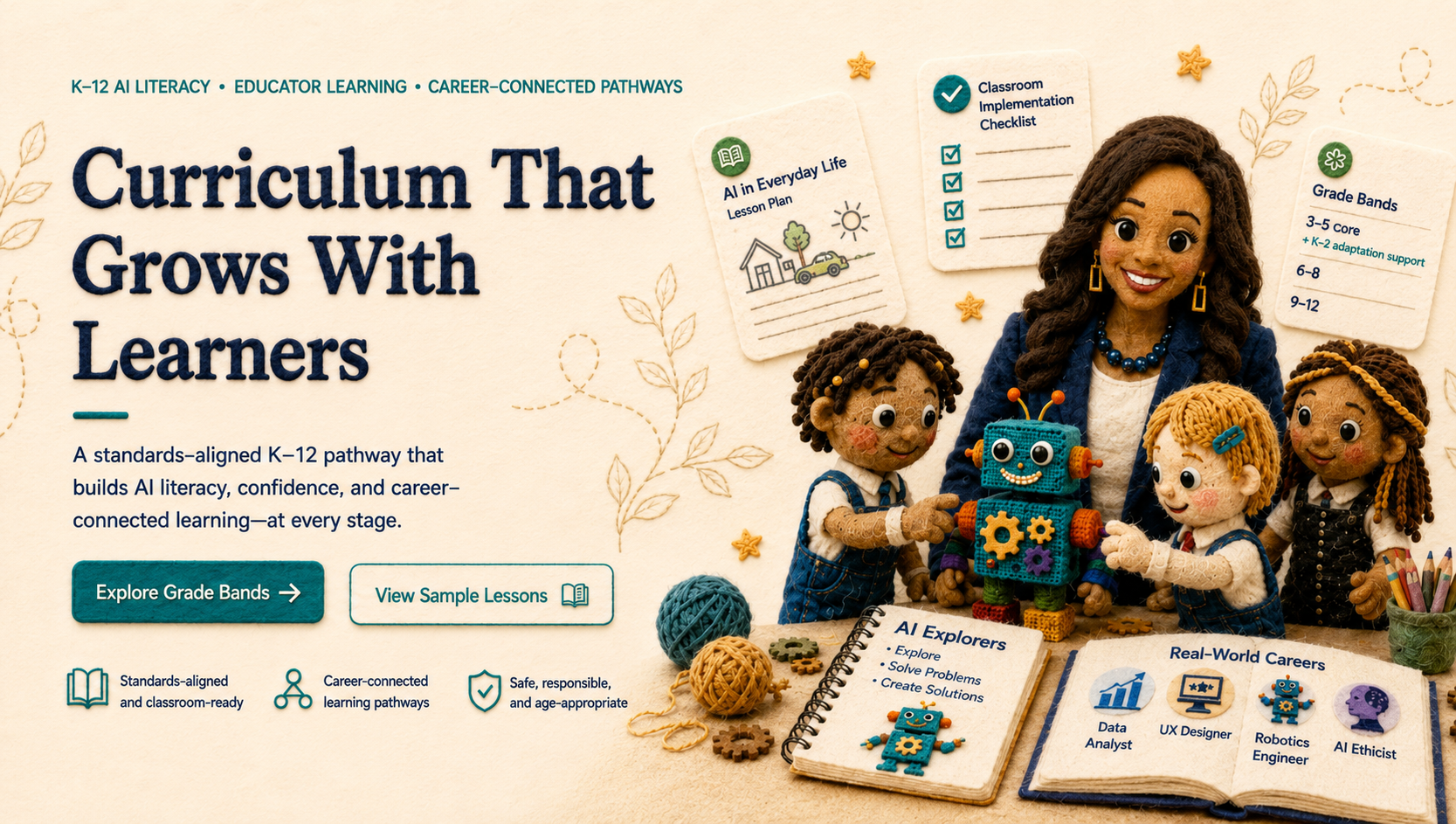
Curriculum That Grows With Learners

Future Ready AI deepens across grade bands: a Grades 3–5 core pathway with K–2 adaptation guidance, an eight-week Grades 6–8 pathway, and a nine-week Grades 9–12 pathway built around responsible judgment and authentic evidence of learning.

Curriculum Introduction

A K–12 Learning Pathway Built for Responsible AI Use

Explore how Future Ready AI helps students build artificial intelligence literacy, digital citizenship, critical thinking, creativity, and responsible decision-making across elementary, middle, and high school.

Andrea Davis-Baptiste Founder & Lead Learning Strategist
Curriculum Overview video transcript

Welcome to the Future Ready AI curriculum.

Our K–12 learning pathways help students understand AI, use it responsibly, and apply it with creativity and human judgment.

AI Discoverers supports elementary learners, AI Explorers supports middle school, and AI Innovators supports high school.

Each pathway builds AI literacy, digital citizenship, critical thinking, and responsible decision-making.

Let's explore the curriculum.

Grade Bands

Three pathways that deepen over time

The learning architecture becomes progressively more analytical, independent, and career-connected from elementary through high school.

Elementary core materials currently begin at Grades 3–5. K–2 educators receive adaptation guidance for teacher-led, developmentally appropriate use; a separate K–2 student workbook is not presented as a completed core pathway.

Elementary School

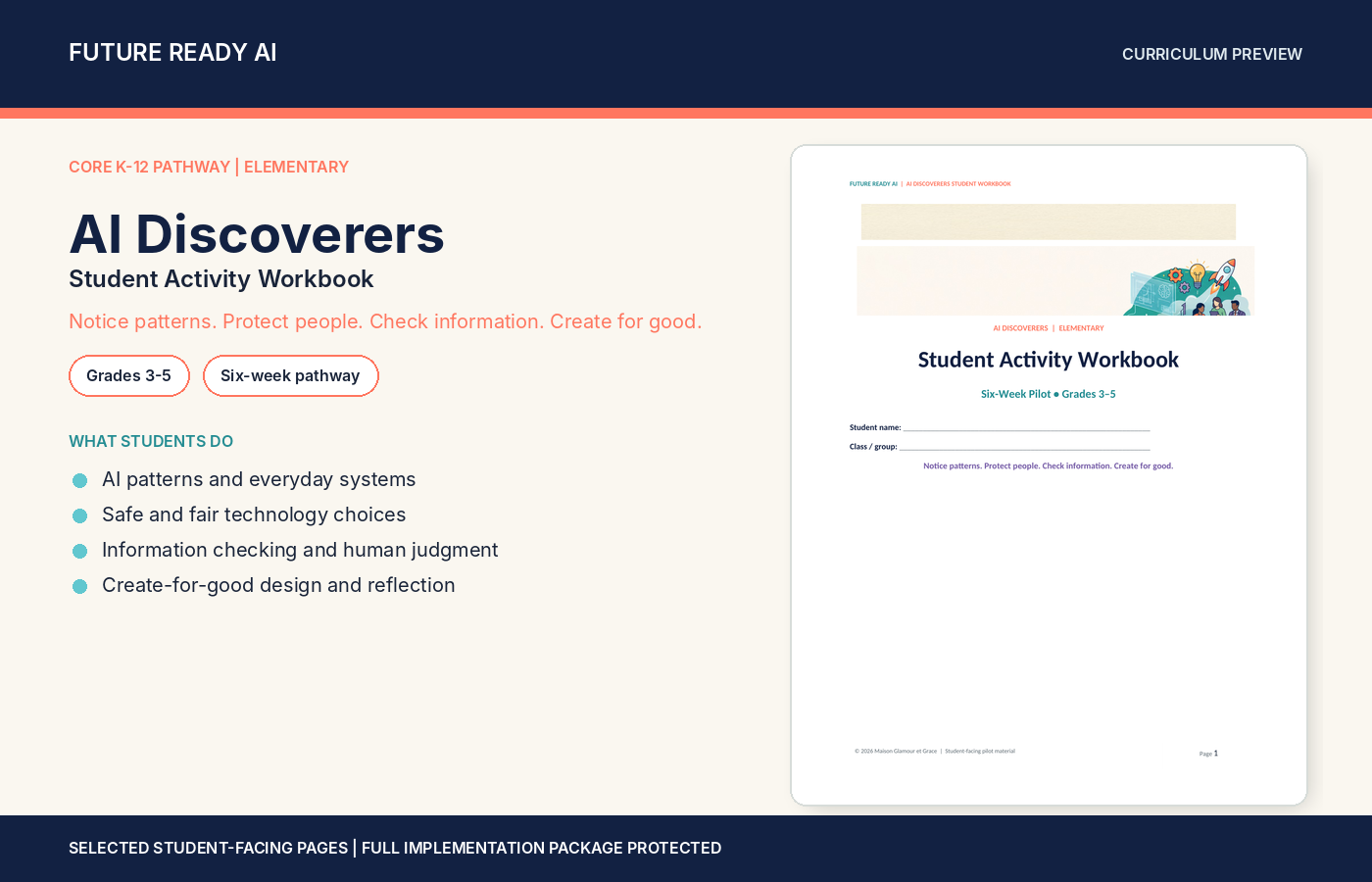
AI Discoverers

Elementary • Grades 3–5Six-week pilot structureNotice • Protect • Check • Create

Sample evidence: classification rules, responsible-use promise, reflection, and Pattern Detectives learning artifacts.

View Pattern Detectives →

Students explore patterns, classification, everyday AI, safe technology use, simple verification, creativity, and foundational digital citizenship.

About this learning pathway

Welcome to AI Discoverers.

Elementary learners explore where AI appears in everyday life while building curiosity, creativity, and safe technology habits.

Students recognize patterns, ask thoughtful questions, and learn to use AI responsibly.
Middle School

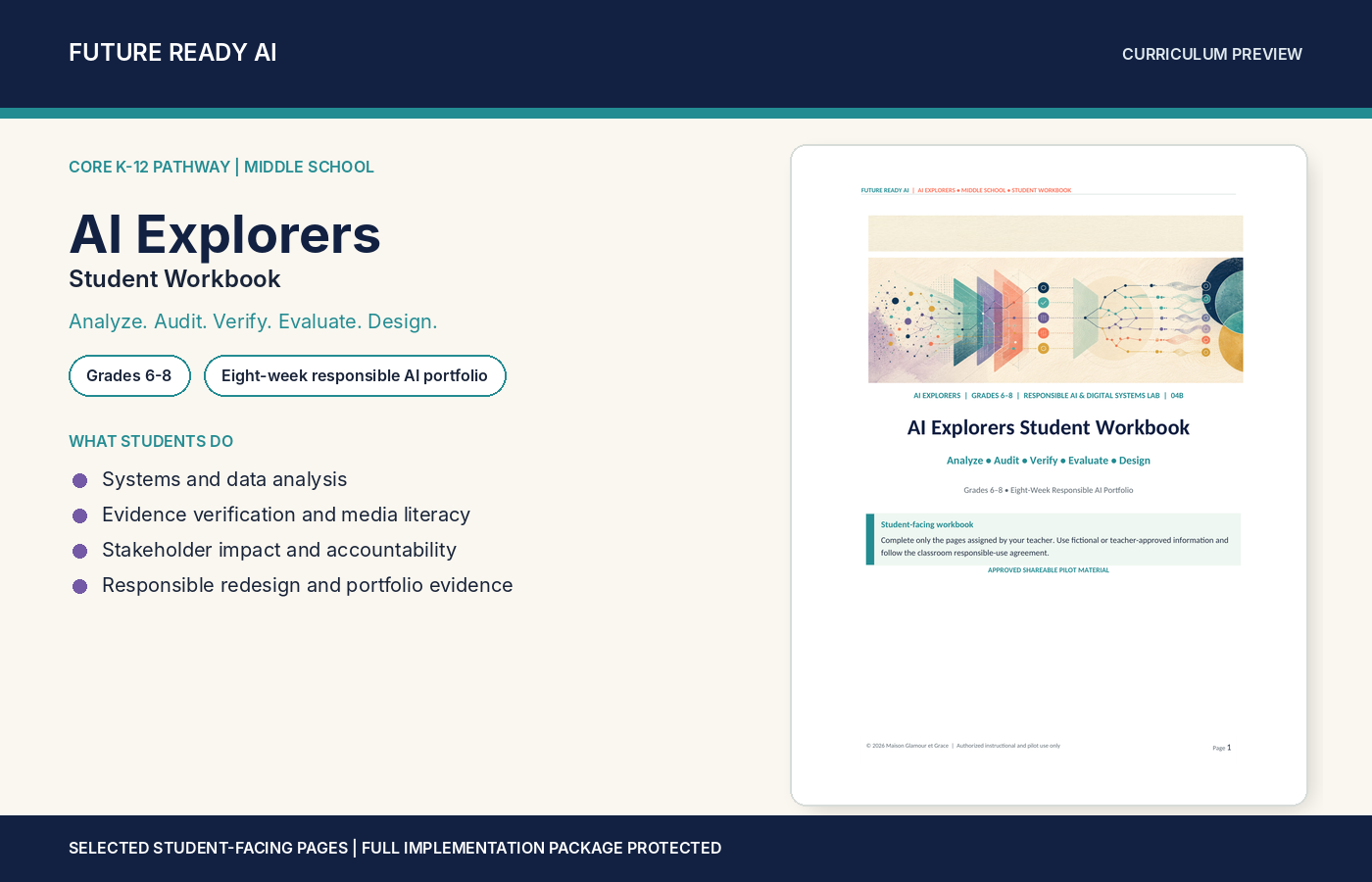
AI Explorers

Middle School • Grades 6–8Eight-week portfolio pathwayAnalyze • Audit • Verify • Evaluate • Design

Sample evidence: system analysis brief, verification record, impact review, design recommendation, and portfolio reflection.

View middle-school scope →

Students examine how AI systems use data and patterns, strengthen prompting and verification, identify bias and privacy risks, and document responsible decisions.

About this learning pathway

Welcome to AI Explorers.

Middle-school learners practice stronger prompting, source-checking, privacy protection, and recognizing bias.

Through collaboration and hands-on projects, students learn to question AI and use it thoughtfully.

High School

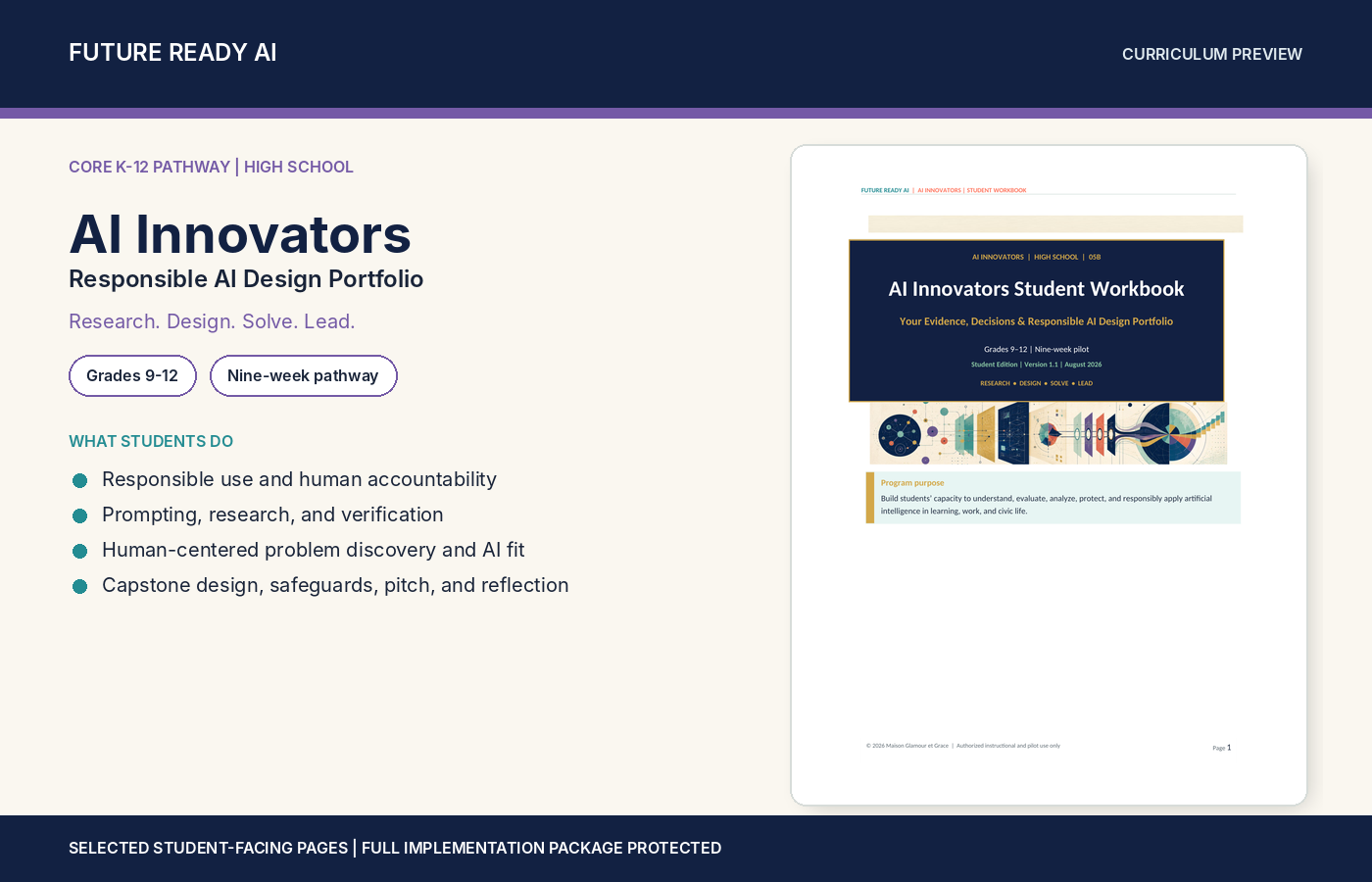
AI Innovators

High School • Grades 9–12Nine-week AI literacy & readiness pathwayResearch • Design • Solve • Lead

Sample evidence: verified brief, AI-use disclosure, safeguard recommendation, risk register, prototype, capstone pitch, and reflection.

Explore AI Innovators →

Students investigate AI systems, research and verification, bias and fairness, synthetic media, human-centered problem discovery, responsible solution design, and career connections.

About this learning pathway

Welcome to AI Innovators.

High-school learners investigate real-world problems, evaluate evidence, examine ethical challenges, and design responsible solutions.

Students prepare to use AI with creativity, integrity, and human judgment.

Explore the full AI Innovators pathway →

Pathway Blueprint

Curriculum structure you can explain in one minute

Each grade band has a defined instructional arc and produces evidence of student thinking—not simply tool usage.

AI Discoverers • 6 weeks

Foundations & responsible habits

  • Patterns, classification & everyday AI
  • Safe technology and privacy habits
  • Simple verification and human review
  • Creativity with student authorship intact
AI Explorers • 8 weeks

Systems, evidence & impact

  • Data, patterns and AI system analysis
  • Prompting, research and verification
  • Bias, privacy and missing perspectives
  • Responsible design portfolio
AI Innovators • 9 weeks

Judgment, design & readiness

  • AI foundations, limitations and ethics
  • Research, synthetic media and fairness
  • Human-centered problem discovery
  • Responsible solution design and capstone

Curriculum Previews

See the student-facing workbooks behind the pathway

These public previews use selected authentic pages from the student materials. Full workbooks, facilitator guidance, answer keys, assessment masters, and implementation files remain protected.

Core K–12 Pathway

One developmental progression from elementary foundations through high-school responsible AI design.

Applied Pathways

Career-connected and innovation experiences extend the core progression without becoming separate brands.

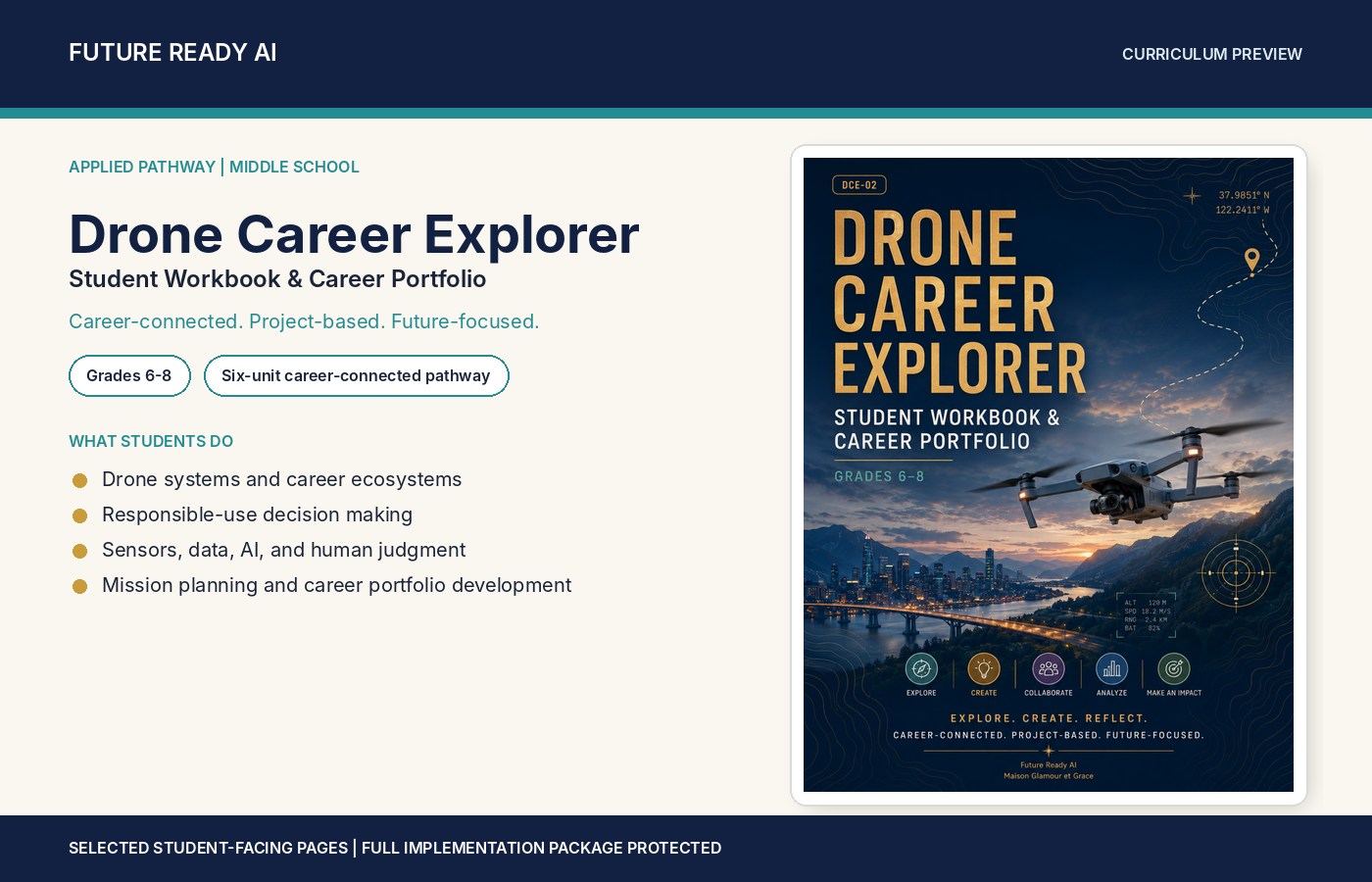
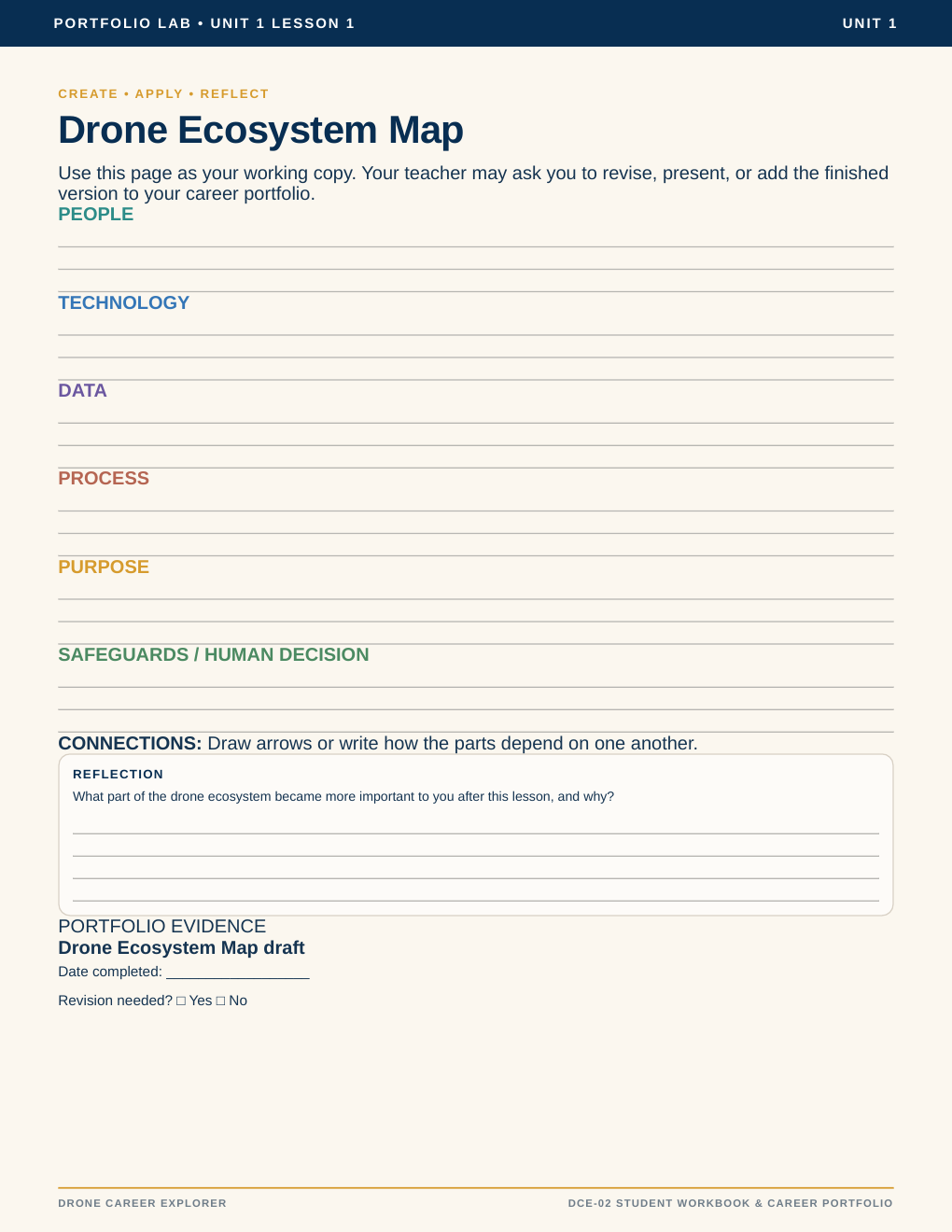
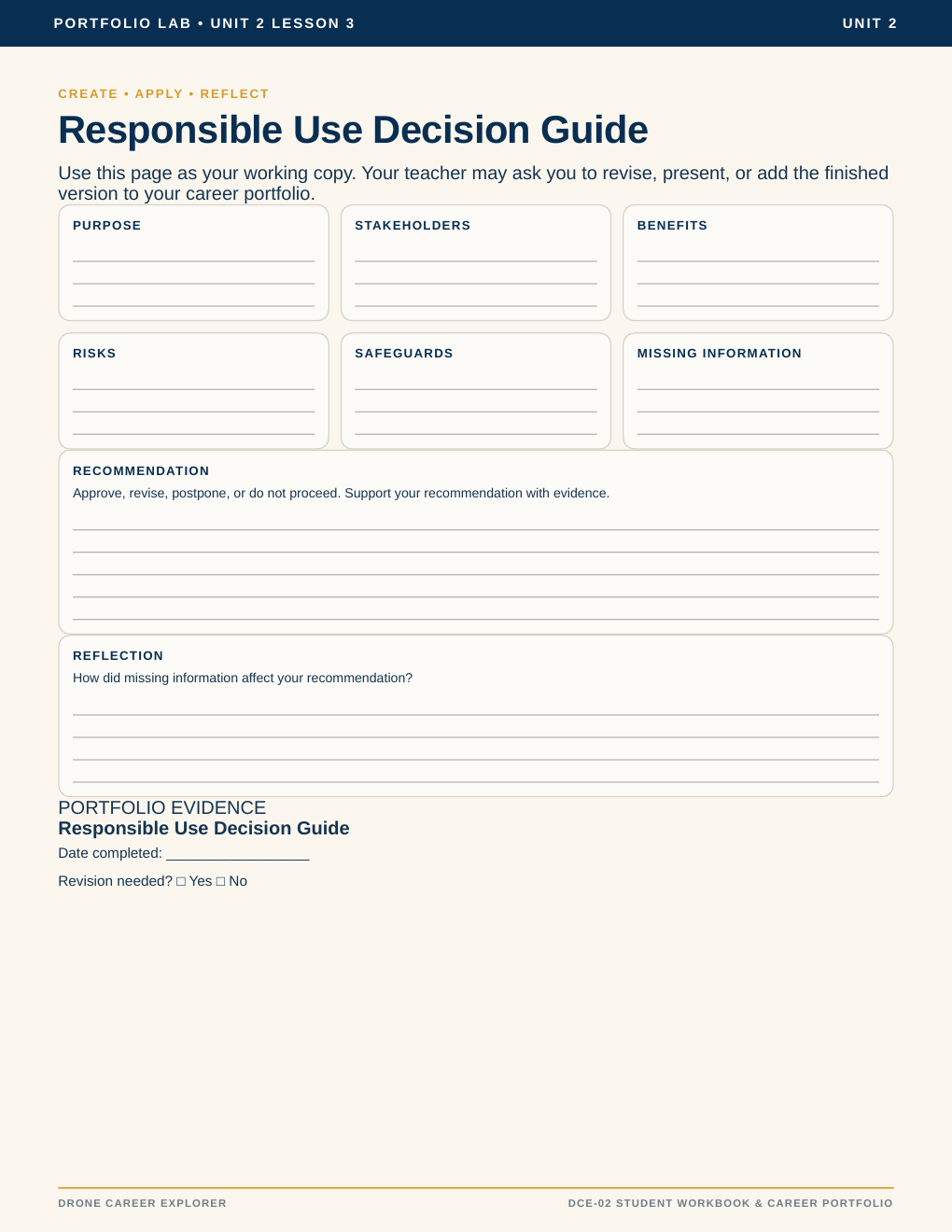
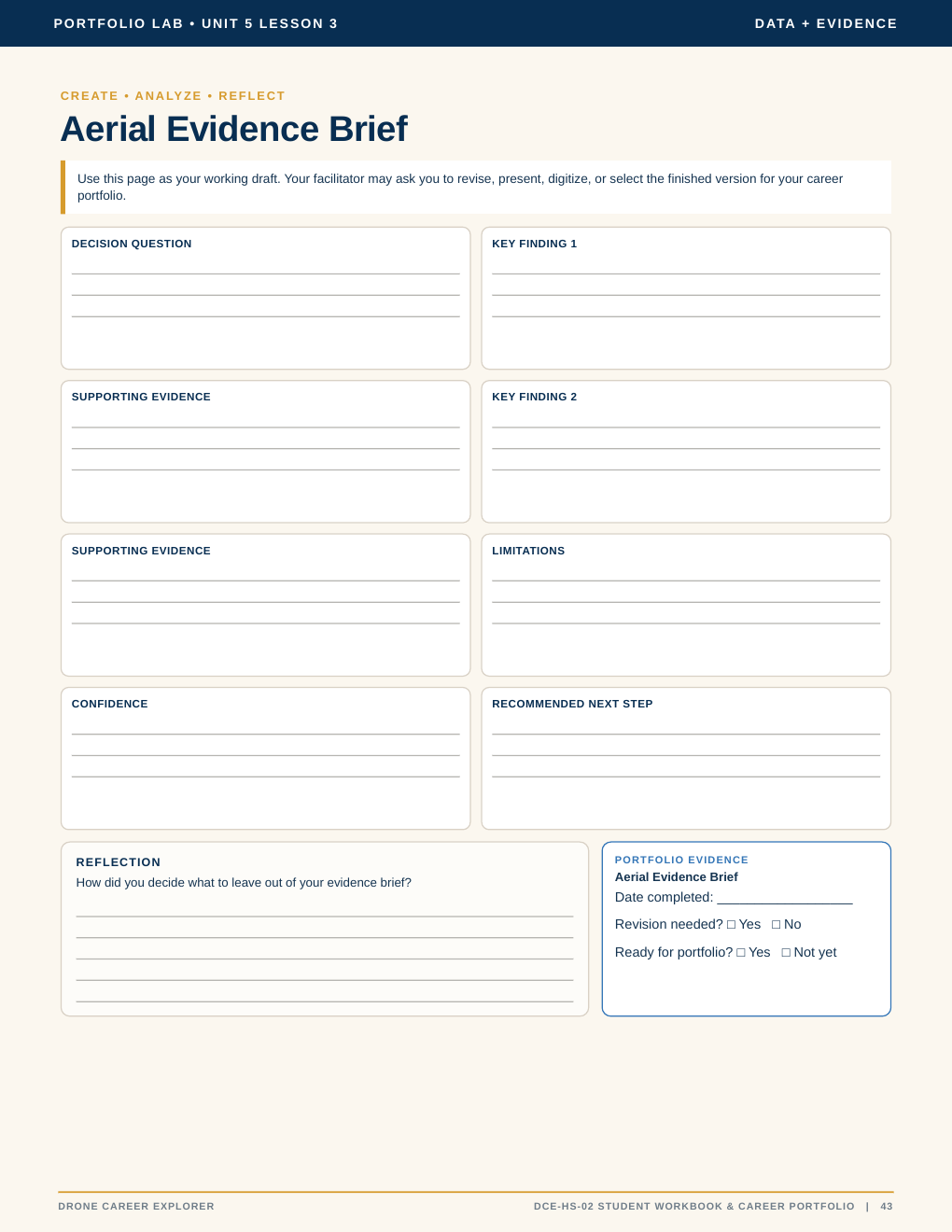
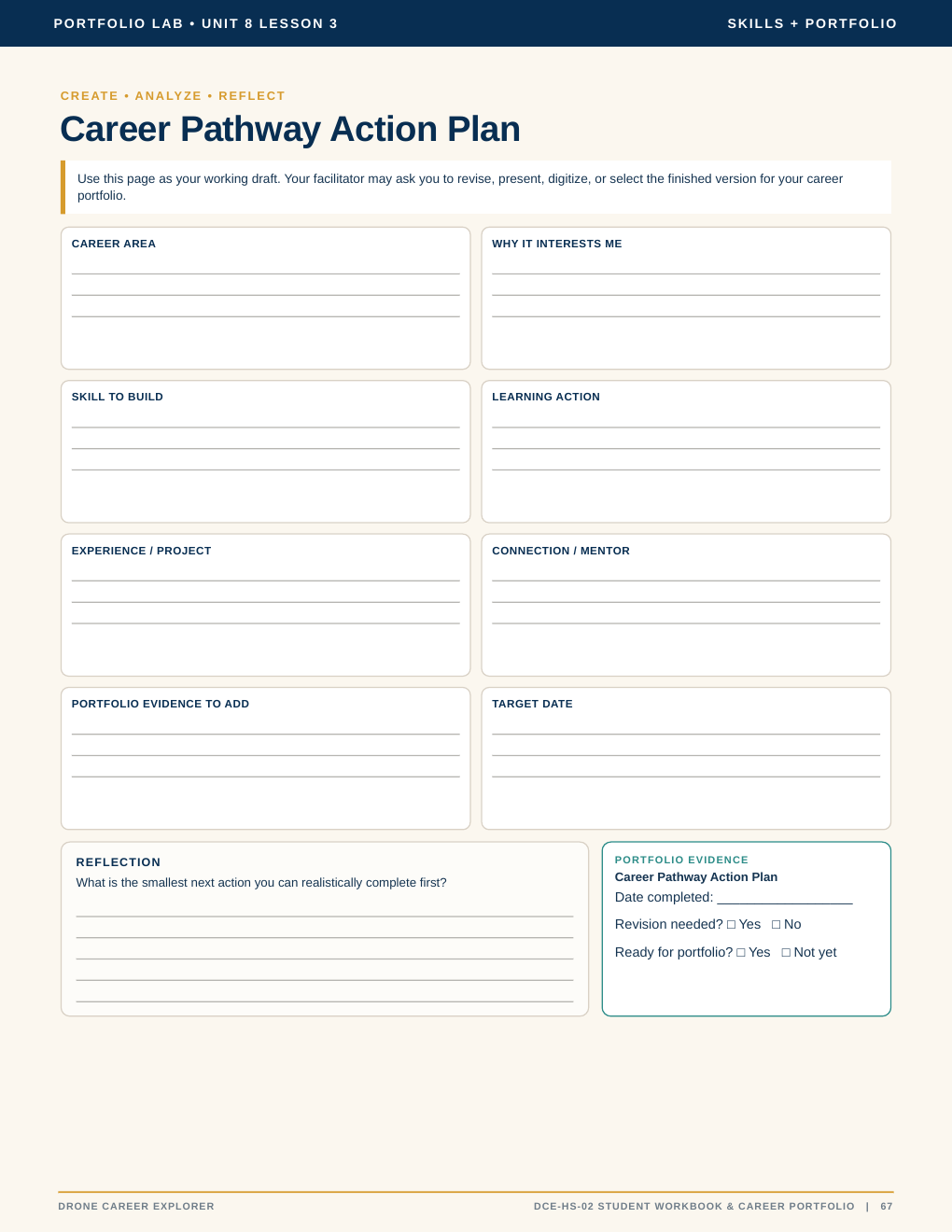
Drone Career Explorer • Grades 6–8 public curriculum preview

Drone Career Explorer • Grades 6–8

Career-connected systems, responsible technology, mission planning, and portfolio evidence.

View public preview →
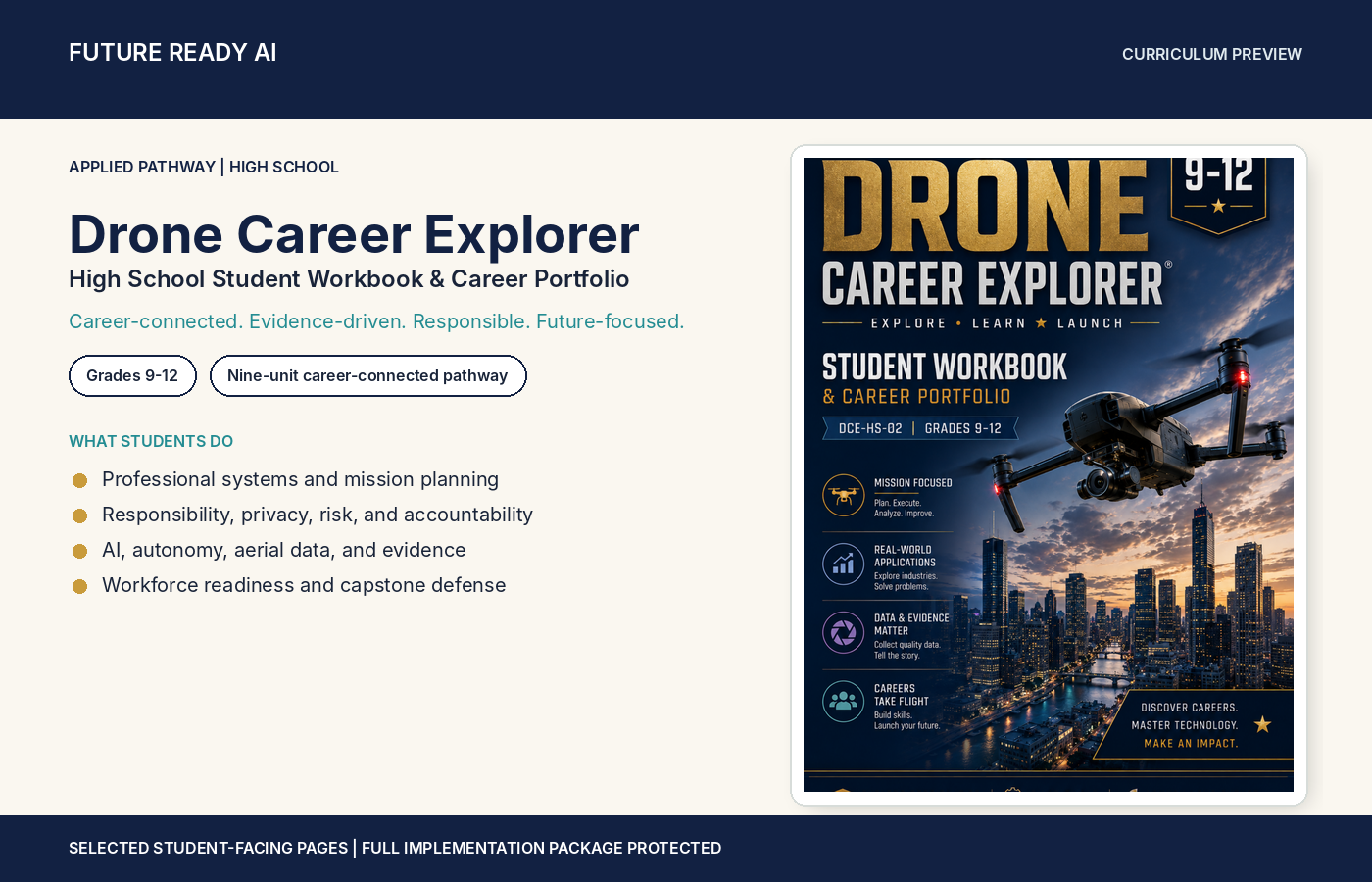
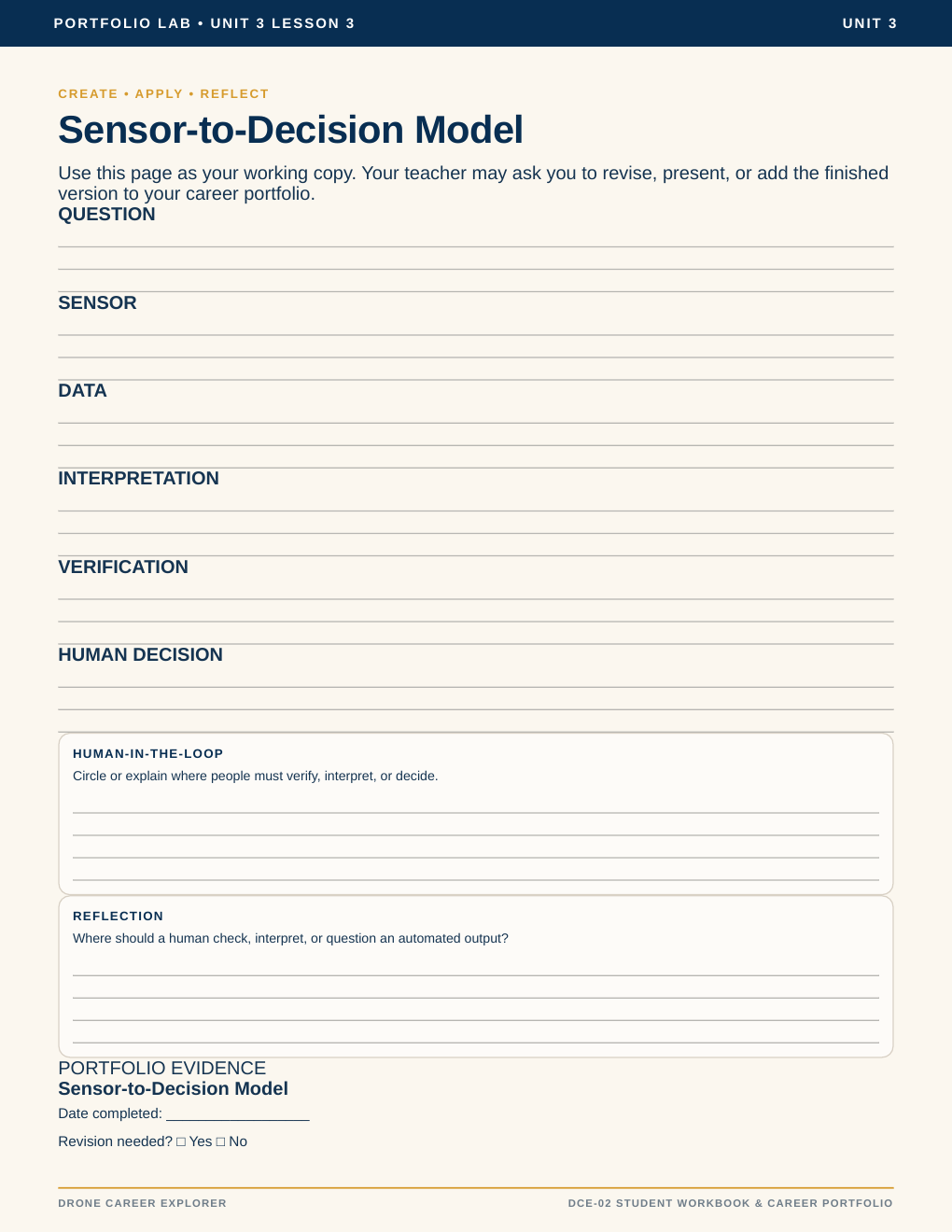
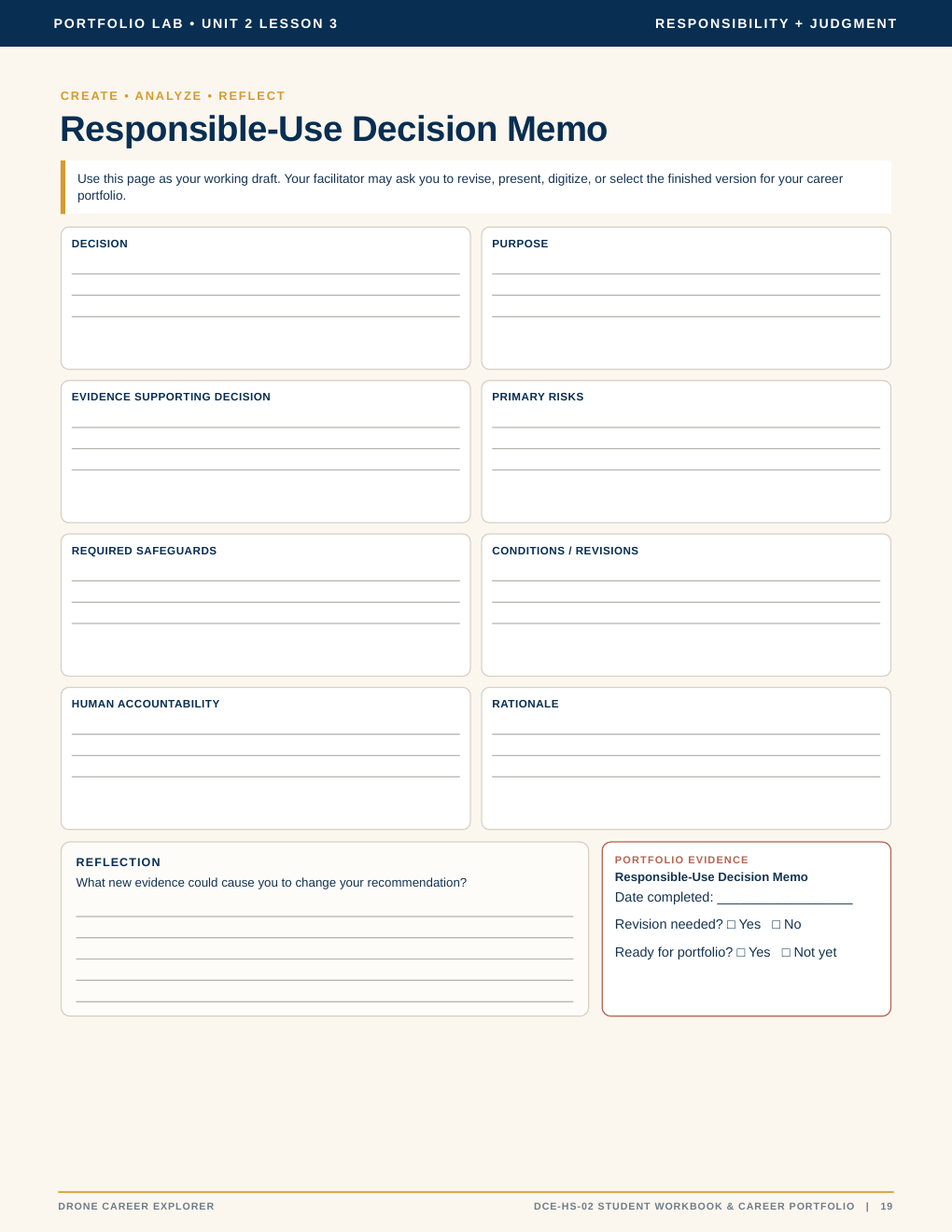
Drone Career Explorer • Grades 9–12 public curriculum preview

Drone Career Explorer • Grades 9–12

Evidence-driven systems, aerial data, workforce readiness, and capstone defense.

View public preview →
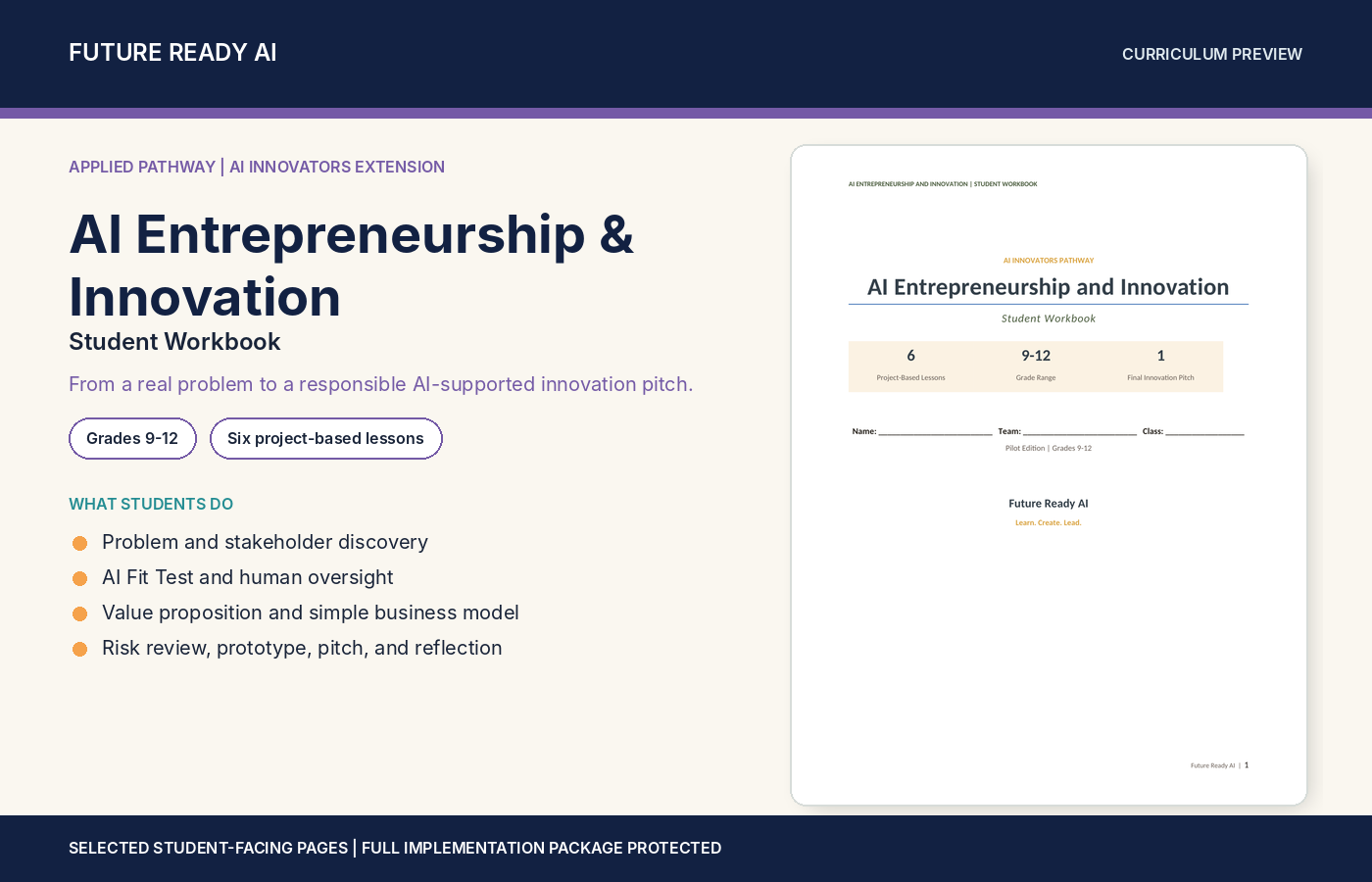
AI Entrepreneurship & Innovation public curriculum preview

AI Entrepreneurship & Innovation

Grades 9–12 extension from problem discovery through responsible innovation pitch.

View public preview →

Learning Objectives

The Six Future Ready AI Curriculum Pillars

AI Foundations

Understanding what artificial intelligence is, how it works, where it appears, and what its limitations are.

Creativity and Innovation

Using AI thoughtfully to support inquiry, design, communication, creativity, and problem-solving.

Responsible and Ethical AI

Examining privacy, bias, fairness, transparency, accountability, and human judgment.

Prompting and Communication

Learning how questions, instructions, context, and revision influence AI outputs.

Critical Thinking and Media Literacy

Evaluating accuracy, recognizing manipulation, verifying information, and identifying missing perspectives.

Digital Citizenship and Future Readiness

Building responsible technology habits while exploring careers, leadership, and emerging opportunities.

Scope and Sequence

The Current Grade-Band Learning Sequences

These sequences reflect the current student-facing workbooks: six weeks for AI Discoverers, eight weeks for AI Explorers, and nine weeks for AI Innovators.

Career-Connected Extension • Grades 6–12

Drone Career Explorer

Drone Career Explorer connects AI literacy to systems thinking, aerial data, responsible technology, mission planning, industry analysis, and workforce readiness. The curriculum is designed to be completed through cases, research, simulation, conceptual planning, and locally supervised experiences.

Pathway Introduction

Inside the Drone Career Explorer Experience

Aerial imaging, mission planning, responsible use, and career-connected learning

This video introduces the kinds of learning experiences students may encounter through Drone Career Explorer, including aerial imaging, mission planning, responsible technology use, teamwork, and career exploration.

Read the pathway introduction transcript

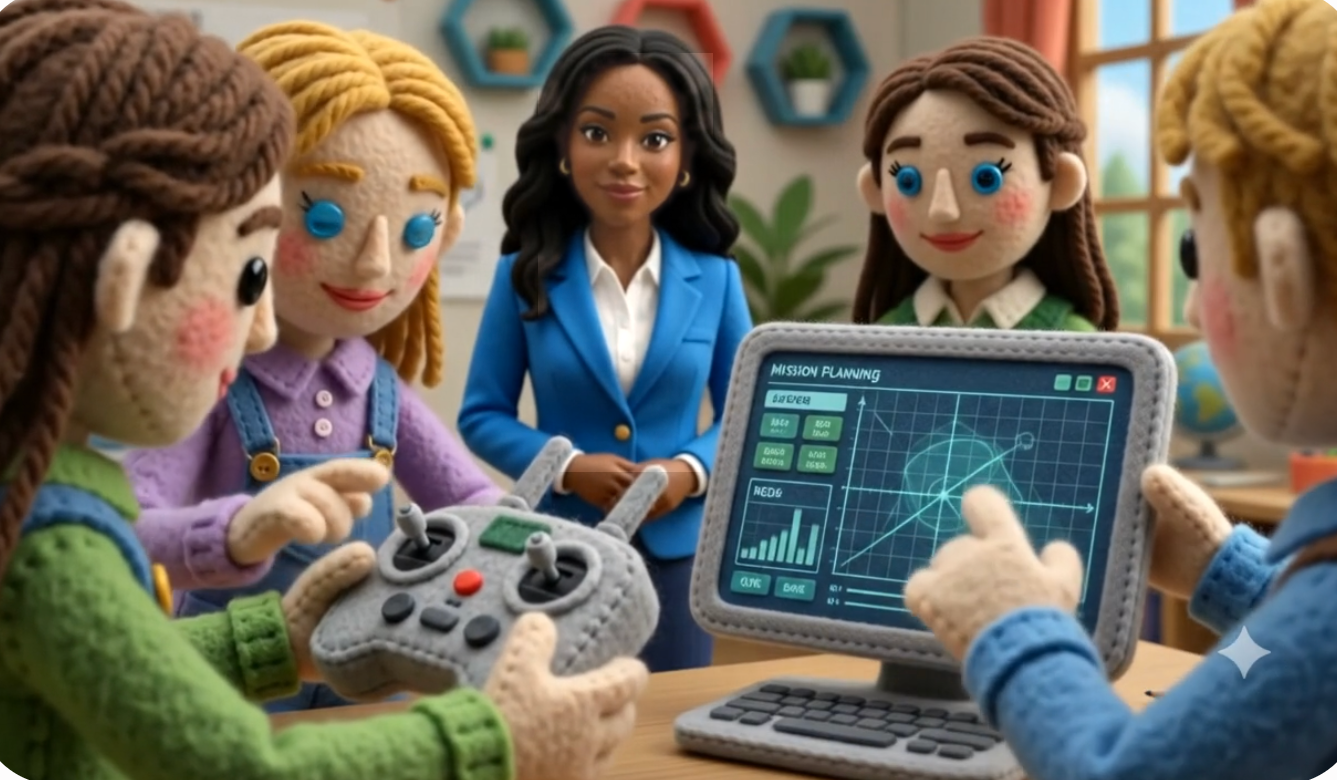
Drone Career Explorer helps students examine flight safety, mission planning, aerial imaging, data, and responsible technology choices through structured learning experiences.

Students connect those decisions to real-world roles and industries while documenting evidence in a career portfolio.

Hands-On Learning Experience

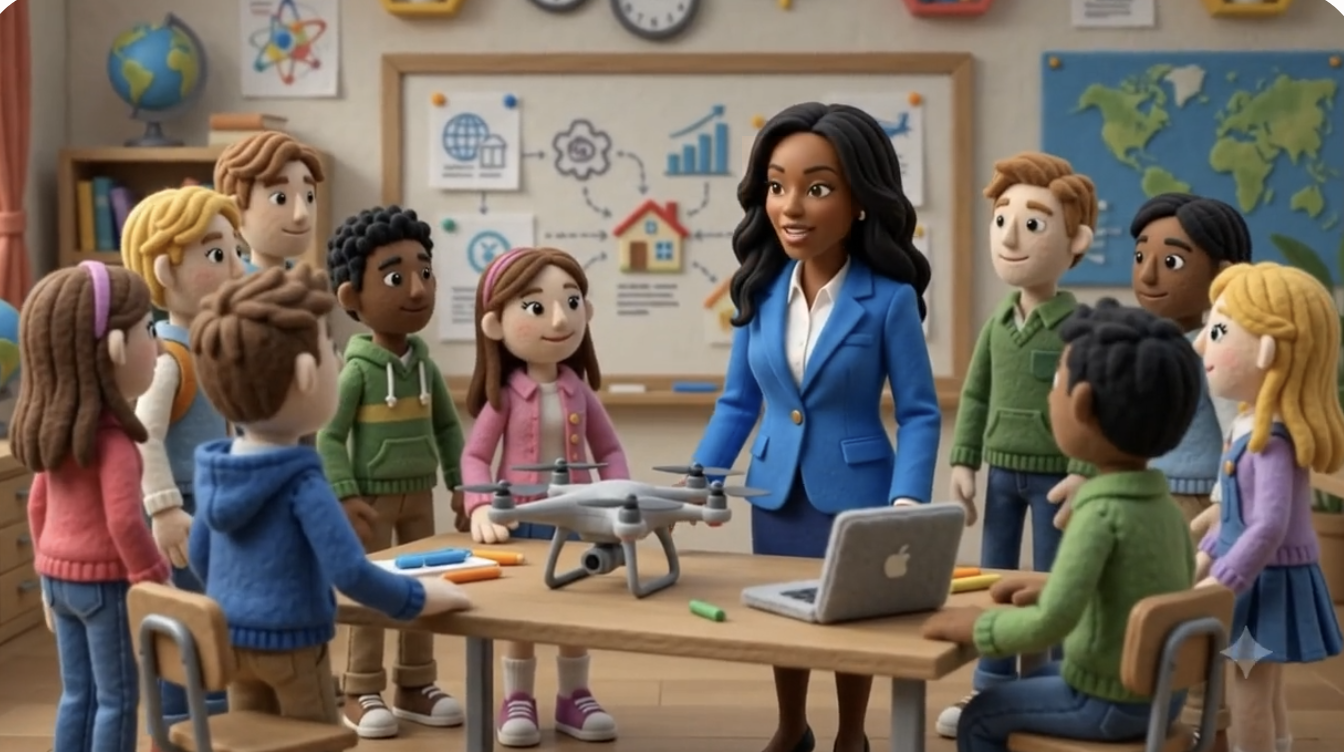
Drone Innovation in Action

Students plan, explore, and solve through hands-on drone learning

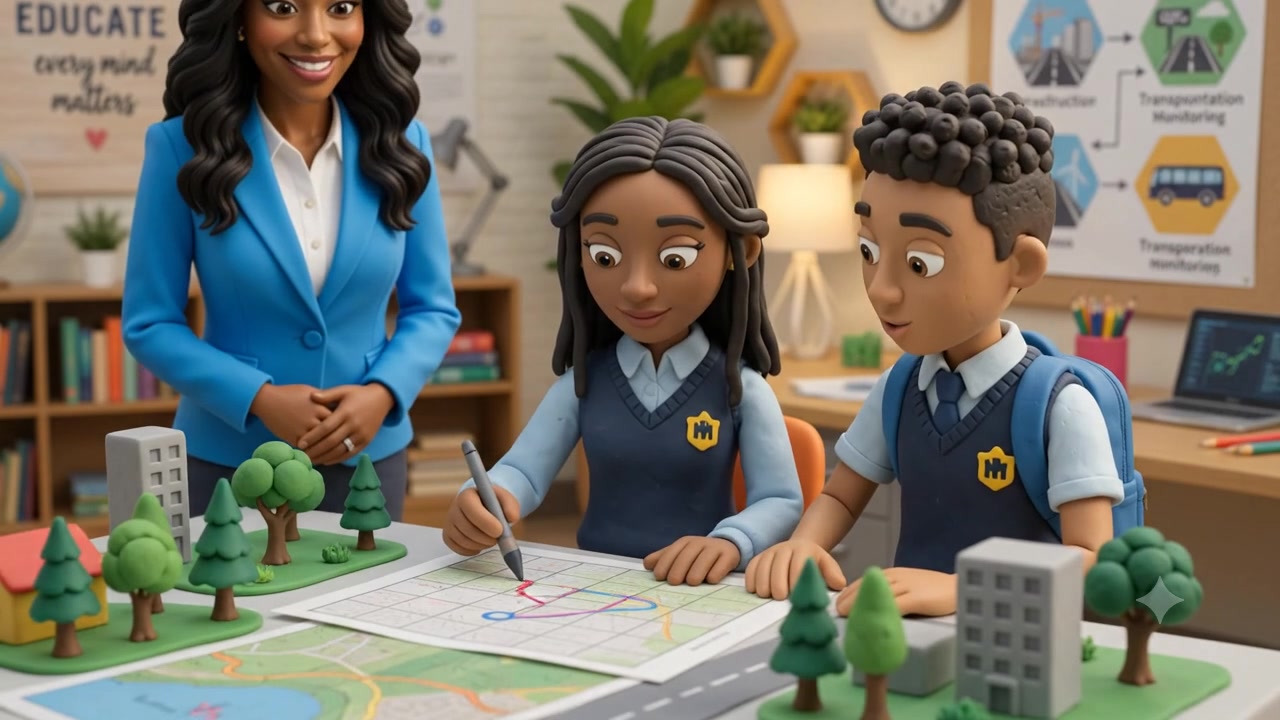
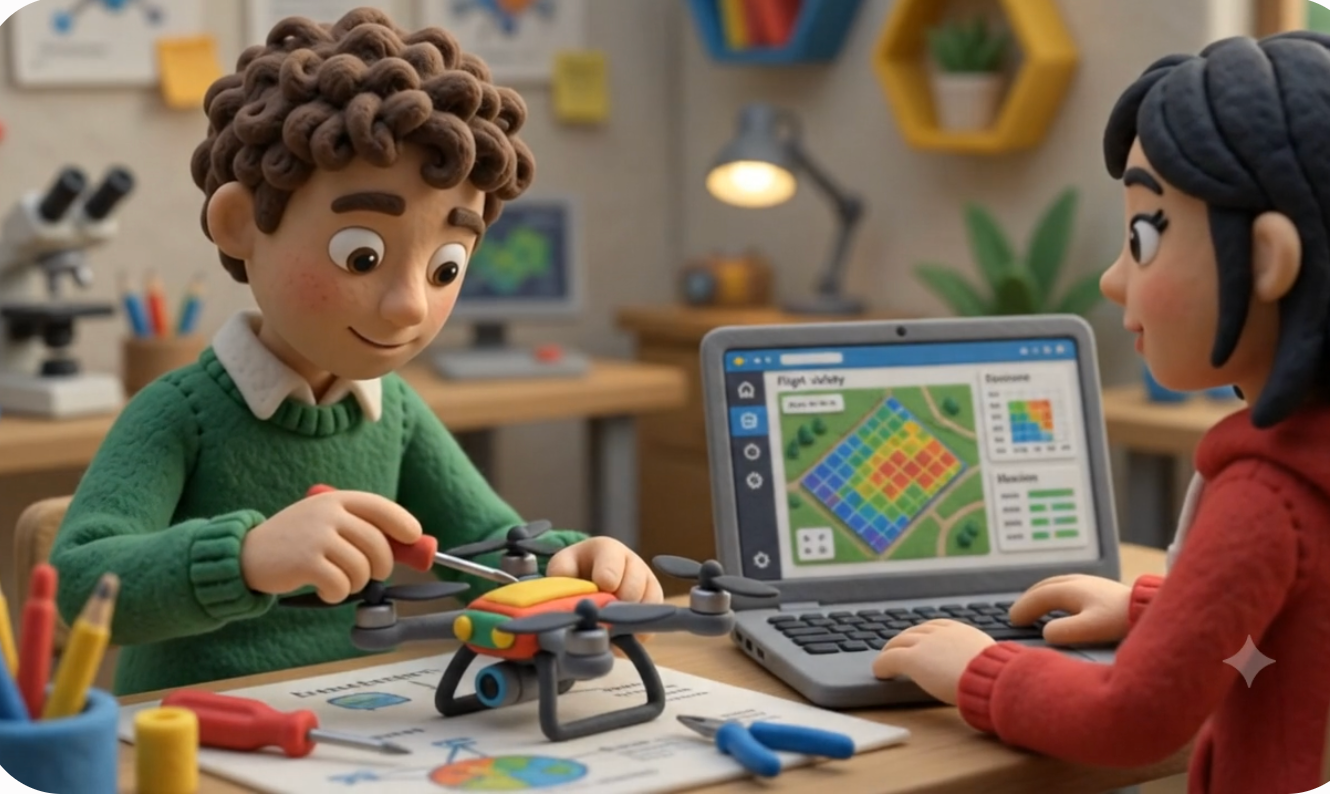
The pathway can include mission planning, aerial-image review, teamwork, and real-world problem-solving activities, with any equipment use determined and supervised locally.

Read the Drone Innovation in Action transcript

Students apply what they learn through mission planning, aerial-image review, teamwork, and real-world problem-solving using responsible drone technology.

Workforce Readiness

Drones, AI & Career Pathways

Workforce Readiness

Drones, AI & Workforce Readiness

Connecting emerging technology to industries and future careers

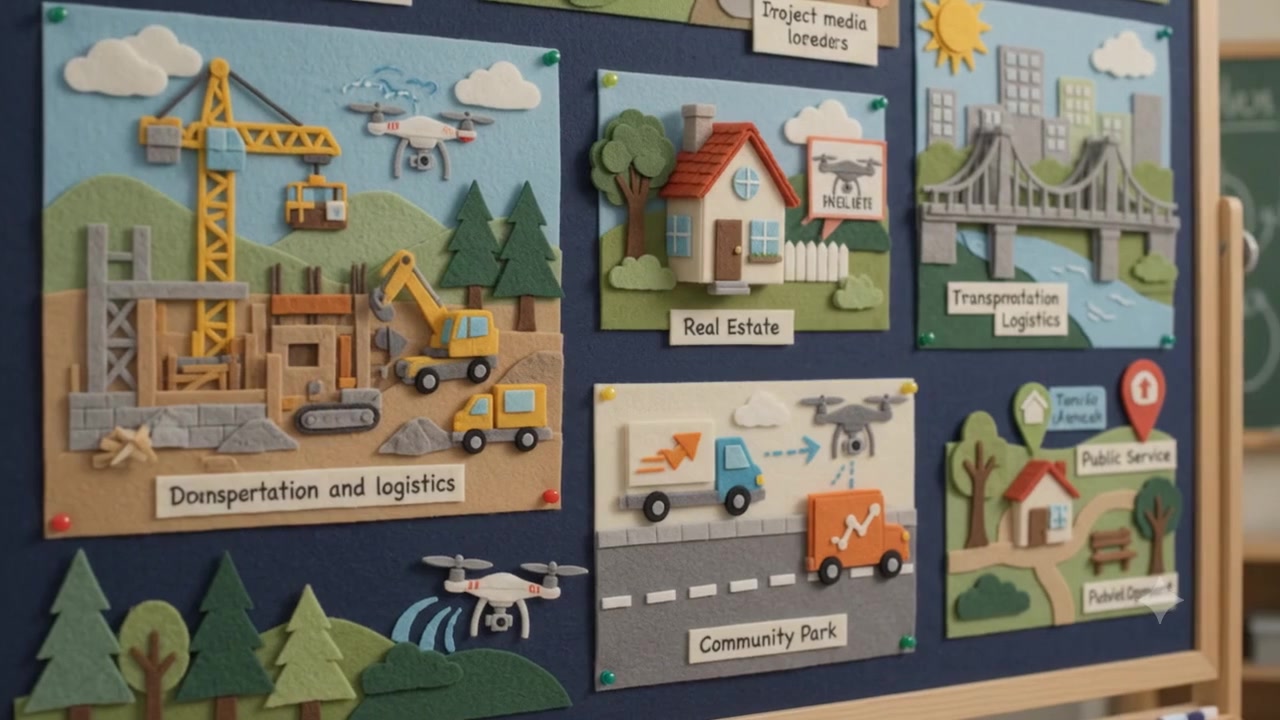
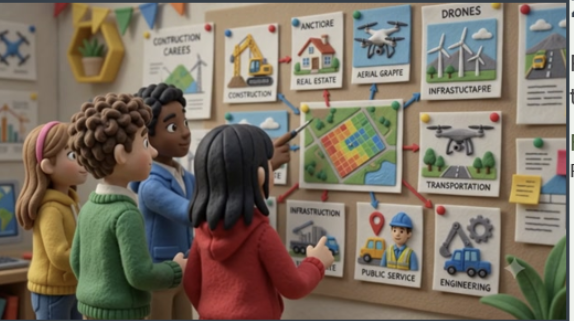
Students connect drone technology and artificial intelligence to construction, real estate, media, transportation, infrastructure, engineering, public service, and other future-focused career pathways.

About this career pathways experience

This experience helps students recognize how classroom learning can transfer into technical fields, creative industries, public-service roles, and emerging technology careers.

Approved Visual Storytelling

Drone learning, systems, and career connections

Selected original artwork retained to support the motion and curriculum evidence.

Career exploration board visual
Career exploration
Drone mission planning visual
Mission planning
Drone learning systems illustration
Systems learning
Drone mission control illustration
Mission control
Drone career pathways illustration
Career pathways
Drone aerial mapping illustration
Aerial mapping & data
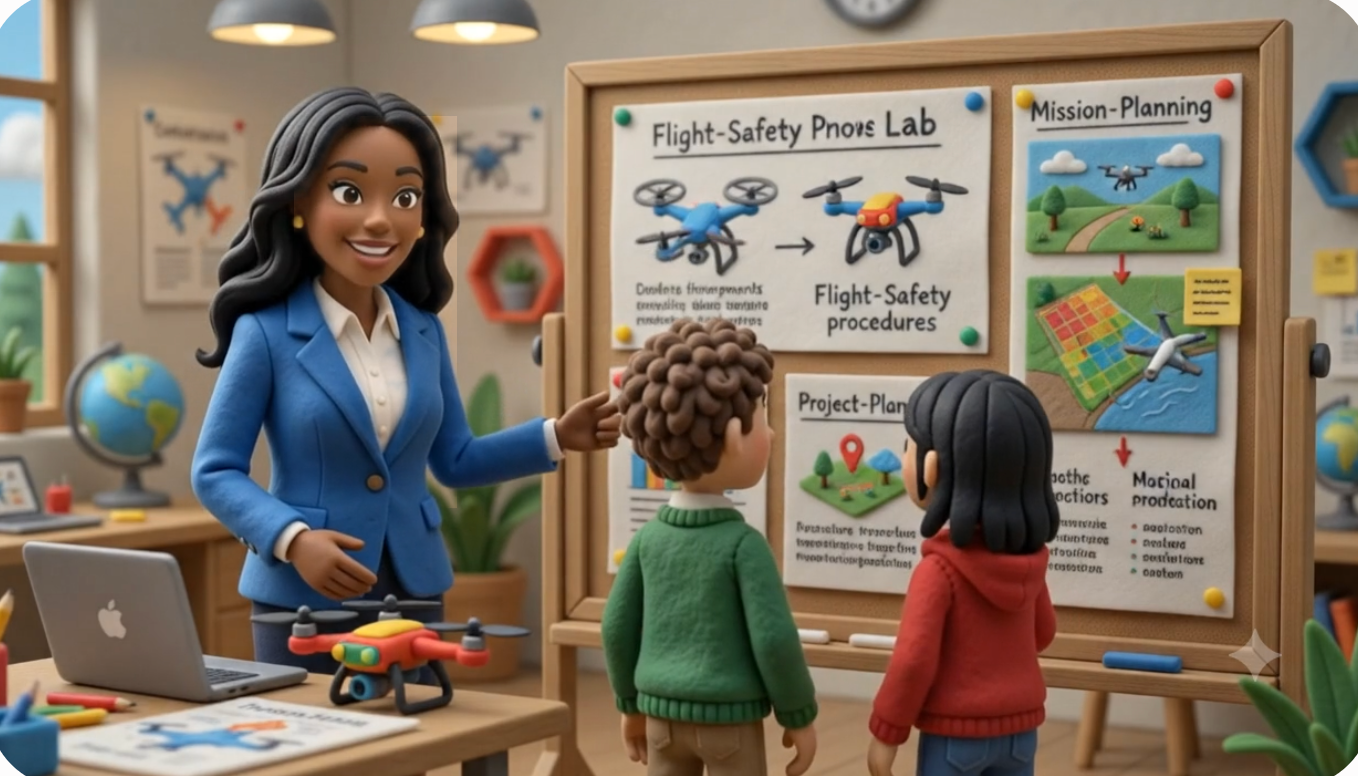
Flight safety and mission planning illustration
Safety & planning

Implementation note: Drone Career Explorer includes protected curriculum, student portfolio, assessment/capstone resources, and implementation guidance. Program delivery, equipment use, pacing, and local permissions are determined with each participating organization; this page does not represent an active cohort or school partnership.

Instructional Design

The Future Ready AI Learning Cycle

Launch

Introduce a question, scenario, challenge, or real-world problem.

Explore

Investigate examples, tools, ideas, evidence, and possible approaches.

Explain

Build understanding through discussion, modeling, and direct instruction.

Create

Apply learning through a product, solution, performance task, or prototype.

Reflect

Evaluate choices, outcomes, responsible use, and the role of human judgment.

Extend

Connect the learning to another subject, career, community, or emerging challenge.

Flagship Sample Lesson

See curriculum evidence—not just curriculum claims

Explore a complete elementary AI-literacy lesson designed for real classroom use, with teacher, student, assessment, family, and presentation resources.

Free Complete Sample

Pattern Detectives: How Machines Notice Similarities

Students investigate how people and machines sort information by noticing patterns and features. They create and compare classification rules, examine possible mistakes or unfair groupings, and explain why human judgment remains essential.

AI Discoverers Grades 3–5 45–60 Minutes No Student AI Account Required

Curriculum pillars: AI Foundations; Critical Thinking and Media Literacy; Responsible and Ethical AI.

Included in the sample

  • Teacher Facilitator Guide
  • Student Activity Book
  • Assessment and Observation Tools
  • Family Connection Page
  • 11-slide Classroom Deck
  • Combined Lesson Package PDF
Preview the classroom deck →

Additional Lesson Concepts

Additional pathway evidence

Spotting the Difference: AI or Human-Made?

Grade Band: Middle School Estimated Time: 45 minutes
Learning Objectives
Students distinguish common characteristics of AI-generated text and images from human-made work, and explain their reasoning.
Key Vocabulary
Artificial intelligence, generated content, bias, verification
Activity Overview
In small groups, students review paired examples of AI-generated and human-made content, discuss identifying clues, and present their reasoning to the class.
Responsible AI Connection
Reinforces the habit of evaluating AI-generated information rather than accepting it at face value.
Assessment Method
Group discussion rubric plus a short individual reflection.
Required Materials
Printed or projected content pairs (provided), discussion guide (provided).

High School

Who Is Responsible When AI Makes a Decision?

Students analyze a decision-making scenario and evaluate fairness, accountability, transparency, and human oversight.

Explore the full lesson →

Career-Connected

Plan a Responsible Drone Mission

Students define a mission goal, review safety and privacy considerations, plan a flight path, and explain how data may support an industry need.

Download the complete Pattern Detectives sample above, or tell us which additional grade band, topic, or implementation need you would like to explore.

Project-Based Learning

From lessons to portfolios, capstones, and transfer

Many units culminate in a multi-day or multi-week project — a student-designed AI ethics campaign, a class-built chatbot concept, or a research presentation — so students apply what they've learned to something real.

Elementary

An AI creativity showcase, a pattern investigation, or a responsible-technology poster.

Middle School

A media-verification campaign, a collaborative chatbot concept, or a digital-citizenship challenge.

High School

An ethics investigation, a career-connected challenge, a responsible drone mission, or a capstone innovation project.

Implementation Matters

The curriculum does not stop at the student workbook.

Future Ready AI is designed as an implementation system for schools—not a folder of disconnected lessons.

Protected teacher-only materials and answer keys are not published on the public website. Public pages show the architecture and selected shareable examples.

01

Curriculum & facilitator guidance

Scope and sequence, lesson architecture, teaching moves, safeguards, differentiation, and implementation notes.

02

Student evidence & assessment

Student workbooks, portfolio prompts, checks for understanding, rubrics, reflection, transfer tasks, and capstone resources.

03

Family & administrator support

Family-facing information, administrator/site pilot planning, technology expectations, and responsible-use communication.

04

Educator professional learning

A seven-session professional-learning architecture covering AI literacy, privacy and student safety, generative AI limitations, research and verification, assessment integrity, bias and fairness, and implementation planning.

05

Classroom & LMS implementation

Posting guidance, teacher-only controls, student-facing sequencing, accessibility checks, and pilot quality assurance.

Standards-informed design: Curriculum development references recognized AI literacy, digital citizenship, computer science, responsible AI, and local instructional requirements while remaining adaptable to school context.

Customization

Adapted to your school, not the other way around

Pacing, examples, and depth can be adjusted to match local standards, schedules, and student needs. Custom curriculum development is available for schools and districts with specific goals.

Request a Sample

See the curriculum for yourself

Tell us which grade band, topic, or implementation need you want to review. Public previews and selected sample lessons are available now; additional protected materials are shared through approved implementation.

This preview form is not yet connected to a submission service. No message is sent from the local review build.