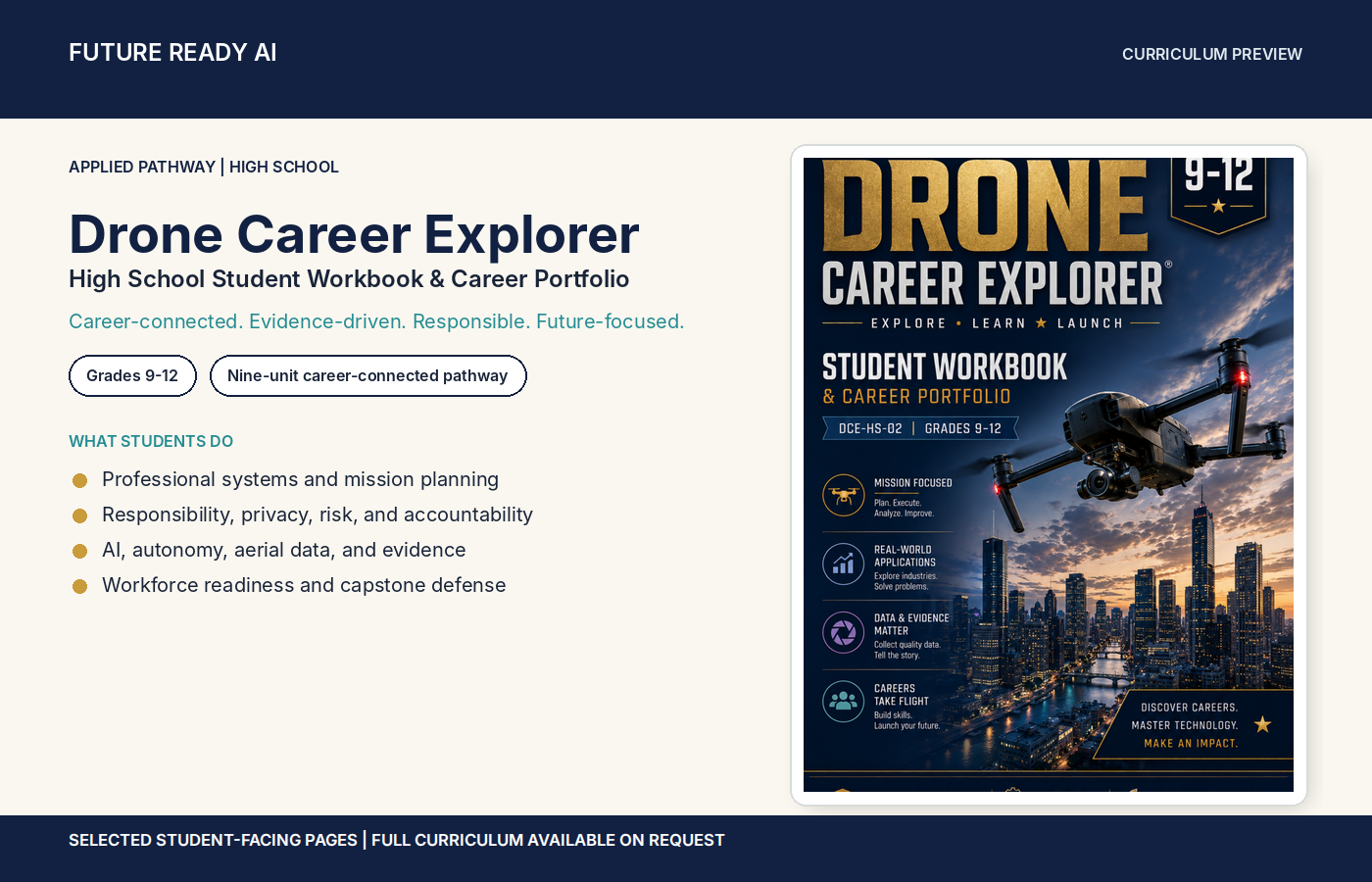
AI Innovators • High School • Grades 9–12

AI Innovators: AI Literacy & Readiness for High School

Students investigate AI systems, research and verification, bias and fairness, synthetic media, human-centered problem discovery, responsible solution design, and career connections.

  • Nine-week pathway
  • Research • Design • Solve • Lead
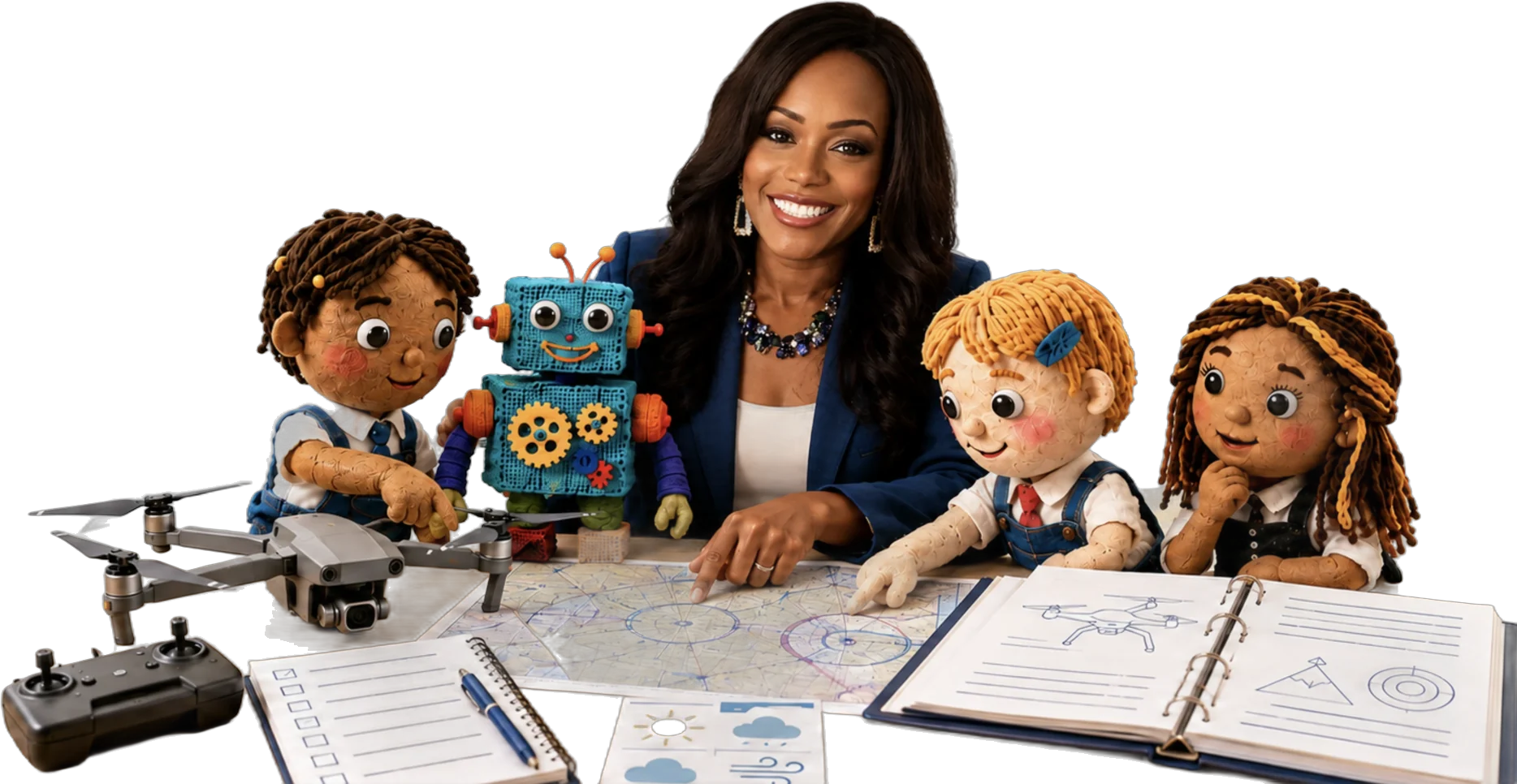
Andrea Davis-Baptiste, founder of Future Ready AI, smiling with the Future Ready AI student puppets and robot at a table with a drone, controller, map, and workbook.

Pathway overview

Watch the pathway overview

High School

AI Innovators

High School • Grades 9–12Nine-week AI literacy & readiness pathwayResearch • Design • Solve • Lead

Sample evidence: verified brief, AI-use disclosure, safeguard recommendation, risk register, prototype, capstone pitch, and reflection.

Explore AI Innovators →

Students investigate AI systems, research and verification, bias and fairness, synthetic media, human-centered problem discovery, responsible solution design, and career connections.

About this learning pathway

Welcome to AI Innovators.

High-school learners investigate real-world problems, evaluate evidence, examine ethical challenges, and design responsible solutions.

Students prepare to use AI with creativity, integrity, and human judgment.
Explore the full AI Innovators pathway →

Scope & sequence

What students learn, unit by unit

Grades 9–12 • Nine-week AI literacy and readiness pathway

Week 1 — AI Around Us: Orientation & Baseline

Map where AI influences daily life, establish baseline understanding, and identify where human choices shape systems.

Week 2 — AI Safety, Ethics & Responsible Use

Apply responsible-use expectations through scenario analysis, decision records, and a learning agreement.

Week 3 — How Generative AI Works—and Where It Fails

Explain generative AI in accessible language and analyze limitations, hallucinations, and unreliable outputs.

Week 4 — Prompting, Research & Verification

Create a verified brief, document evidence, and disclose meaningful AI assistance.

Week 5 — Bias, Fairness & AI-Supported Decisions

Examine stakeholder impact, missing context, fairness, and safeguards in an AI-supported decision.

Week 6 — Media Literacy & Synthetic Content

Verify synthetic or altered content and communicate appropriate disclosure.

Week 7 — Human-Centered Problem Discovery & AI Fit

Develop a problem statement, stakeholder map, and evidence-based test of whether AI is appropriate.

Week 8 — Responsible Solution Design & Career Connections

Create an AI role map, risk register, safeguards, and prototype while connecting work to career skills.

Week 9 — Capstone Pitch, Reflection & Post-Assessment

Defend the solution, evidence, limitations, safeguards, human authority, and next steps through a portfolio and pitch.

View the full AI Innovators pathway →

Student-facing materials

Preview the workbooks

Public previews of the student workbooks for this pathway.

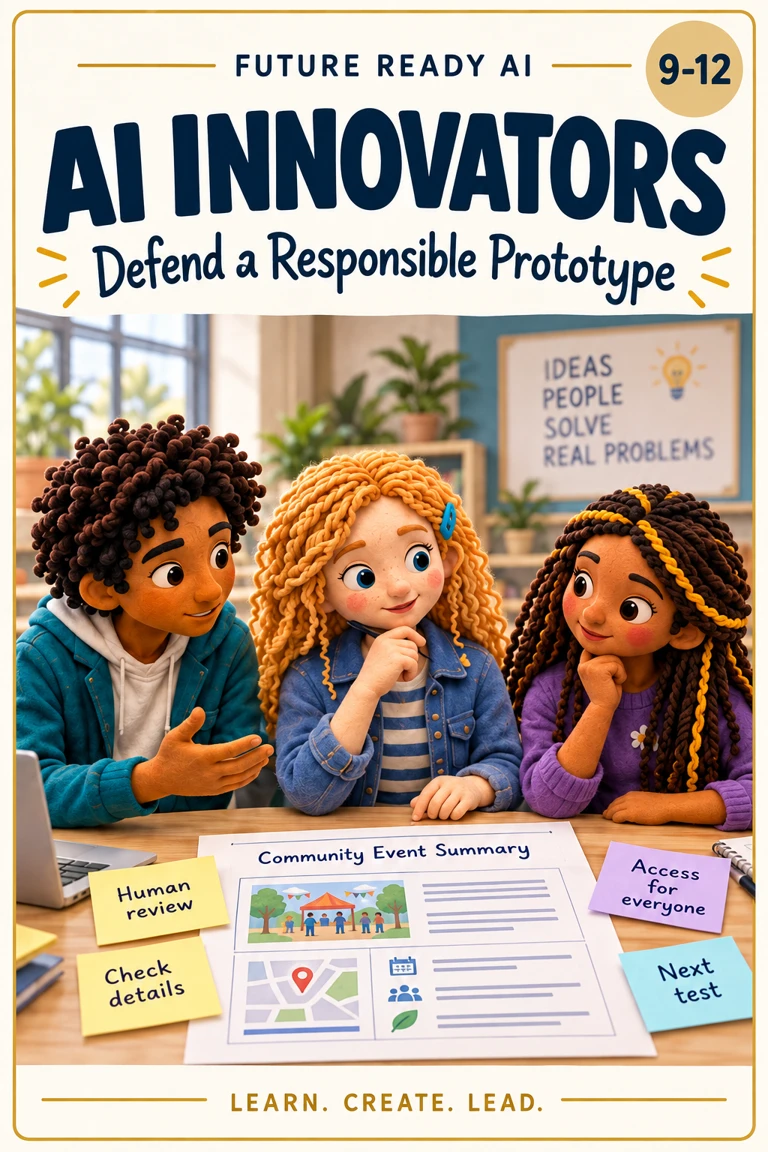
Lesson cover for “Defend a Responsible Prototype,” AI Innovators, Grades 9–12: three students review a community event summary prototype with notes on human review, checking details, access, and the next test.

AI Innovators · Grades 9–12

Defend a Responsible Prototype

Students investigate a community need, compare solutions, define human review and safeguards, and defend a prototype with a next-test plan.

Public lesson sample · PDF

View Lesson Sample (PDF, opens in a new tab)
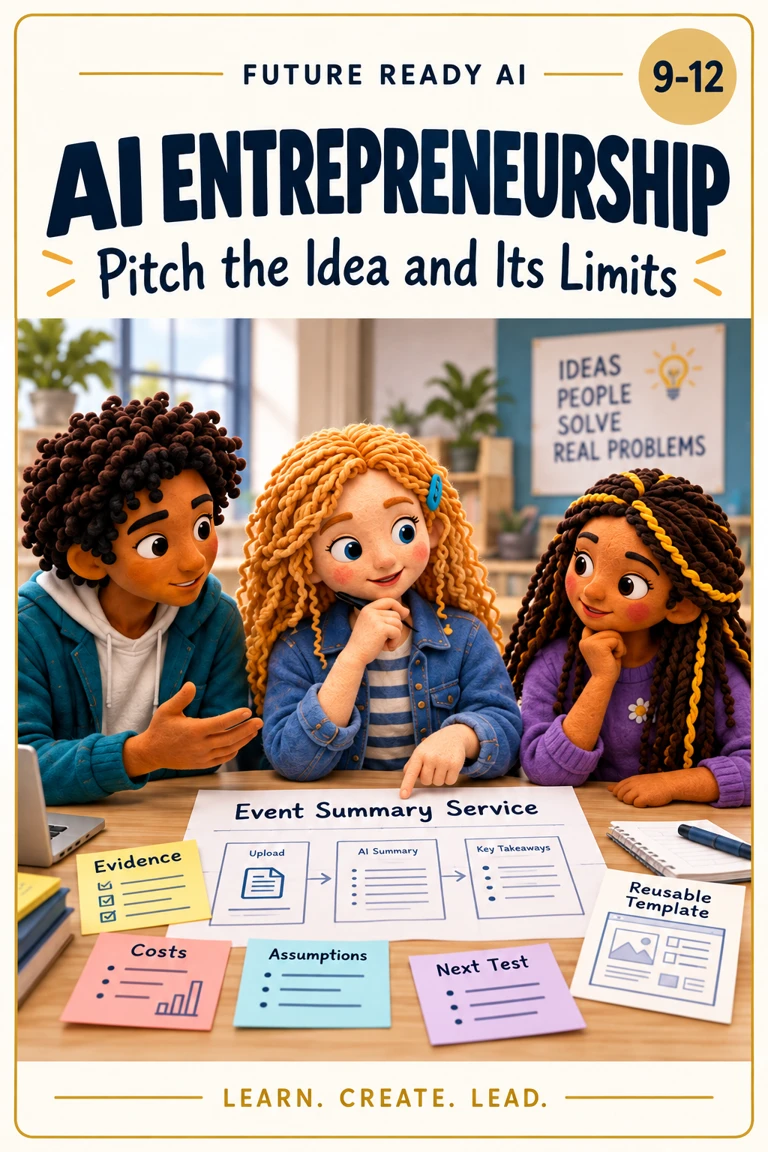
Lesson cover for “Pitch the Idea and Its Limits,” AI Entrepreneurship, Grades 9–12: three students plan an event summary service with notes on evidence, costs, assumptions, and the next test.

AI Entrepreneurship · Grades 9–12

Pitch the Idea and Its Limits

Students investigate a need, develop a service concept and delivery model, assess risks, and pitch an evidence-based next test.

Public lesson sample · PDF

View Lesson Sample (PDF, opens in a new tab)

Sample lessons

See a lesson from this pathway

High School

Who Is Responsible When AI Makes a Decision?

Students analyze a decision-making scenario and evaluate fairness, accountability, transparency, and human oversight.

Explore the full lesson →

Student Framework

Five Competencies for Responsible AI Literacy

Understand

Understand what AI systems do, how they use data, and how they generate predictions, recommendations, or content.

Evaluate

Evaluate accuracy, source evidence, limitations, and whether AI-generated information can be trusted.

Analyze

Recognize bias, missing context, unequal impact, and potential harm.

Protect

Protect privacy, safeguard sensitive information, and use AI responsibly.

Apply

Apply human judgment, communicate decisions, and remain accountable for outcomes.

Curriculum Design

AI Innovators Curriculum Strands

The pathway can be delivered as a sequence, integrated into existing courses, or introduced through selected lessons and interdisciplinary projects.

AI Foundations

Core concepts, systems, data, predictions, and the basic building blocks of artificial intelligence.

Media Literacy

Evaluating AI-generated content, misinformation, source credibility, accuracy, and evidence.

Bias and Fairness

Examining data, representation, unequal outcomes, missing context, and equitable decision-making.

Digital Citizenship

Privacy, safety, disclosure, academic integrity, appropriate use, and responsible participation.

Generative AI

Creative problem-solving, responsible prompting, verification, revision, and thoughtful human-AI collaboration.

Career and CTE Connections

Real-world applications across business, technology, media, health science, engineering, manufacturing, transportation, construction, drones, and aviation.

AI Governance and Human Oversight

Transparency, accountability, appeal processes, responsible decision-making, and the role of human judgment.

High School Career Pathway

AI Entrepreneurship and Innovation

Pilot Module Available

This complete six-lesson module helps students explore how artificial intelligence can support innovation, entrepreneurship, and community problem-solving. Students identify an authentic need, investigate potential users, design a responsible AI-supported solution, and communicate its value through a business or community-impact pitch.

Applied Module Preview

Six Project-Based Lessons for Grades 9–12

The module works in business, entrepreneurship, computer science, CTE, career education, or interdisciplinary settings. It can be completed without requiring students to use a generative AI tool.

Grades 9–12 Six Lessons 60 Minutes Each Project-Based Career-Connected Responsible AI Human Accountability

Applied Module Includes

  • teacher implementation guide and six lesson plans
  • student workbook and discovery activities
  • value proposition and business-model templates
  • responsible AI risk review
  • prototype and concept-development activities
  • editable eight-slide pitch deck
  • pre- and post-assessments
  • performance rubric and student reflection
Teacher Resource

Teacher Implementation Guide

Curriculum architecture, learning objectives, pacing, final challenge, assessments, materials, lesson plans, facilitation guidance, and scoring tools.

Request the Teacher Guide →
Student Resource

Student Workbook

Discovery activities, AI Fit Test, value proposition, business-model canvas, risk review, prototype planner, rubric, assessments, and reflection.

View Lesson Sample →
Editable Template

Student Pitch Deck

An editable eight-slide presentation that guides teams from the problem and discovery evidence through responsibility, prototype learning, and the next test.

Request the Pitch Deck Template →

Six-Lesson Sequence

From Problem Discovery to Responsible Innovation Pitch

Each lesson produces one artifact students need for the final business or community challenge.

Lesson 1

What Makes a Problem Worth Solving?

Students identify a specific need, evaluate its impact and scope, and create an evidence-focused problem statement.

Lesson 2

Customer and Community Discovery

Students map stakeholders, ask neutral questions, synthesize evidence, and identify needs, barriers, and missing perspectives.

Lesson 3

How Can AI Support the Solution?

Students test whether AI is appropriate, compare simpler alternatives, and map inputs, outputs, limitations, and human review.

Lesson 4

Value Proposition and Business Model

Students explain the value created and complete a simple model for delivery, resources, sustainability, and success.

Lesson 5

Responsible Innovation: Privacy, Bias, Access, and Harm

Students review transparency, harm, safeguards, appeal, monitoring, and human accountability before revising the concept.

Lesson 6

Build and Pitch the Solution

Students test a low-fidelity prototype, communicate evidence and safeguards, respond to questions, and identify a responsible next step.

Featured Project

Design an AI-Powered Solution for a Community or Business Challenge

Students work individually or in teams to develop an ethical, useful, and realistic AI-supported concept. The experience can culminate in a pitch presentation, prototype, business-model canvas, or community-impact proposal.

Identify

Define a meaningful business, school, or community problem.

Discover

Learn about potential users, stakeholders, and current solutions.

Design

Develop an AI-supported solution and value proposition.

Evaluate

Examine privacy, bias, accessibility, feasibility, and potential harm.

Build

Create a prototype, concept model, business canvas, or implementation outline.

Pitch

Communicate the solution, evidence, value, safeguards, and next steps.

Student Tool

Five Questions for Responsible AI Decisions

A reusable framework students apply whenever they evaluate an AI-supported decision, tool, or recommendation.

Purpose

What decision or problem is the AI system supporting?

Data

What information is being used, and is it accurate and relevant?

Impact

Who could benefit, be excluded, or be harmed?

Fairness and Transparency

What may be missing, biased, unclear, or difficult to challenge?

Human Oversight

Who reviews the result, who has final authority, and how can a decision be appealed?

Start With the Pilot

Bring AI Entrepreneurship and Innovation to Your Students

Preview the student workbook, or talk with us about using the module in a classroom, department, CTE, entrepreneurship, interdisciplinary, or innovation-showcase setting. The complete teacher and template package is shared with schools and districts on request.

Standards-informed: designed to support skills reflected in the ISTE Standards for Students, CSTA K–12 CS Standards, AI4K12 Five Big Ideas, and digital citizenship & media literacy, with responsible-AI guidance from UNESCO and the voluntary NIST AI RMF. Not a certified or formally completed alignment.

See standards-informed design →